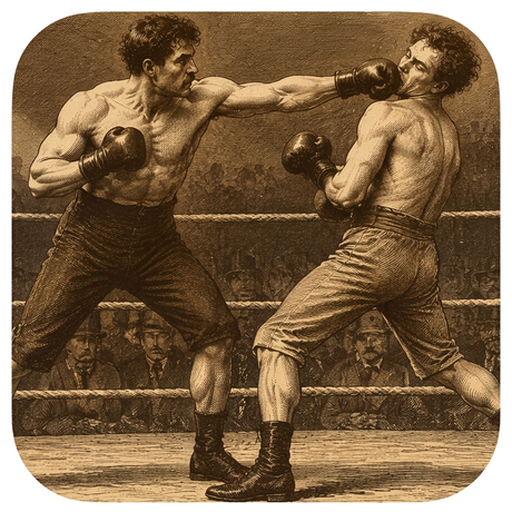
Special Selection · The Manassa Mauler
Dempsey vs Willard
The day Toledo shook
July 4, 1919. A heavyweight crown, seven first-round knockdowns, and one of boxing’s most brutal championship fights.
An independent historical feature · Not affiliated with The Ring magazine · Contains discussion of serious sporting injuries.
- Date
- July 4, 1919
- Location
- Bay View Park Arena, Toledo, Ohio
- At stake
- World heavyweight championship
- Result
- Dempsey wins · RTD 3
Willard’s corner stopped the contest before round four; three rounds were completed.
From the photographic archive
Two genuine fight photographs and the original souvenir program. Images are shown in full, without cropping or fabricated blood effects.
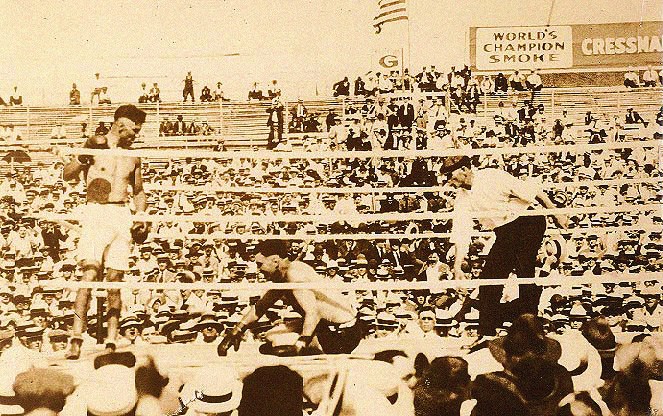
Willard on the canvas, Dempsey nearby. This genuine fight photograph captures the close proximity of attacker and fallen opponent before the modern neutral-corner procedure.
Photographer unknown · July 4, 1919 · Public domain in the United States
01 · Before the bell
A giant champion. A hungry challenger.
Jess Willard had taken the title from Jack Johnson in Havana in 1915. His only subsequent title defence before Toledo was against Frank Moran in 1916. Dempsey, meanwhile, forced himself into contention by stopping Fred Fulton in the first round in July 1918.
The title match was signed in February 1919, with Toledo confirmed as the host in May. Promoter Tex Rickard put the championship on an Independence Day stage: an outdoor arena at Bay View Park. Willard entered as a slight betting favourite, but Dempsey brought speed, pressure and a devastating close-range attack.
Jack Dempsey
Challenger · 6′1″ · 187 lb
Jess Willard
Champion · 6′6½″ · 245 lb
Reported fight measurements; historical sources can differ.
02 · Fight commentary
Three rounds that changed the crown
Editorial reconstruction, not a transcript of a live broadcast.
Round 1 · Seven knockdowns
Dempsey closes the distance on the much taller champion. A left hook brings the first knockdown; the assault then becomes a cycle of Willard rising and Dempsey attacking again. Seven times Willard goes down in the opening round. With no requirement for Dempsey to retreat to a neutral corner, the champion has little room to recover.
At the round’s end, confusion over the count and the timekeeper’s whistle leads Dempsey to believe he has won. He leaves the ring, then returns when the contest continues.
Round 2 · Survival under pressure
Willard stays upright. There are no further knockdowns, but Dempsey continues to dominate. The contest is no longer the expected test of the challenger against a giant champion: it is a badly hurt champion trying to survive.
Round 3 · The end between rounds
Willard endures another round of punishment. His corner stops the fight before the fourth begins. Dempsey is the new world heavyweight champion: a third-round retirement, not a first-round knockout.
03 · Inside the attack
The left hook & the “Dempsey Roll”
The hook that broke the distance
The opening left hook put Willard down and overturned the apparent advantage of size. In technical terms, Dempsey’s threat was getting inside the taller man’s reach and transferring his body weight into short punches. His own later instructional book explains weight transfer, the falling step and power punching.
Bobbing, weaving, then striking
“Dempsey Roll” is a popular modern label for the weaving, rolling attack associated with him. Here it describes the idea of moving the head and body off the centre line, then punching from that movement—not a claim that the 1919 fight featured a formally named sequence or the stylised technique seen in modern entertainment. Dempsey’s own instruction discusses bobbing and weaving.
Archive integrity: the available close-up photograph shows a right hand. It is not presented as photographic proof of the first left-hook knockdown.
04 · The rules mattered
No modern neutral-corner protection
In Toledo, Dempsey could remain close to Willard after a knockdown rather than being sent to a distant neutral corner. The account of the contest describes him being allowed to resume attacking once both of Willard’s gloves were off the canvas. That rule environment helps explain the relentless first-round succession of knockdowns.
Under the modern neutral-corner procedure, the standing boxer must move away while the referee attends to the fallen opponent. That creates separation before action resumes. Toledo’s brutality should be read in its own rule context, not mistaken for a modern referee ignoring today’s procedure.
05 · History & its legends
“The worst beating in boxing history”?
Toledo has the reputation of a championship bloodbath: seven opening-round knockdowns, a visibly battered champion, and a one-sided stoppage. Calling it the “worst beating in boxing history”, however, is a dramatic judgement—not an official ranking or a medically established comparison.
Accounts of Willard’s injuries conflict. Later retellings describe broken bones and lost teeth; other accounts dispute the extent of those injuries. The article therefore does not present the familiar catalogue of fractures as settled fact. The sustained punishment and his corner’s decision to stop are enough to explain the fight’s lasting notoriety.
Loaded-glove stories also followed the fight. Those allegations were disputed and are not established here as fact. Dempsey’s victory belongs in the record; the more lurid lore belongs in a clearly marked debate.
Related fighters & title fights
Fighter profiles
- Jack Dempsey →
The challenger who became champion in Toledo.
- Jack Johnson →
Willard’s predecessor as heavyweight champion.
- Gene Tunney →
The champion who later faced Dempsey in the Long Count rematch.
Jess Willard does not yet have a dedicated profile in this archive.
Historic title-fight features
- Dempsey–Firpo →
1923-09-14 · Polo Grounds, New York
Seven knockdowns in round one, and Firpo knocked Dempsey through the ropes before Dempsey won in the second.
- Dempsey–Tunney II →
1927-09-22 · Soldier Field, Chicago
The famous “Long Count” fight—Dempsey’s knockdown of Tunney lasted well past ten seconds.
- Johnson–Jeffries →
1910-07-04 · Reno, Nevada
Johnson dominated the “Fight of the Century” against the retired former champion.
Editorial notes
This feature was compiled from historical reporting and archival research and reviewed on October 11, 2026. It is not independent verification of every historical claim; contemporary reports and later recollections can disagree. Disputed claims — the injury catalogues, the loaded-glove allegations and the “Dempsey Roll” label — are identified as such in the text above.